By Ema Sasic
Move over, Edgar Allan Poe, a new master of the macabre has emerged. American director Robert Eggers showed early on his love of all things dark and creepy, beginning with his deliciously sinister “The Witch,” and later pushing the psychological boundaries of his characters, like in the claustrophobic and maddening “The Lighthouse” and mythological tale “The Northman.” With each film, he effectively gave horror/psychological thriller fans a new auteur to champion.
With “Nosferatu,” Eggers’ reimagining of the 1922 German Expressionist film about the Transylvanian vampire, the director shows just how brilliantly he has found his stride within the genre. His telling of this classic story is a dark, twisted nightmare for the ages, one whose images hauntingly linger with viewers for a long time, as if Nosferatu himself is the director. Eggers’ singular vision comes together in each frame, as the technical and visual elements immerse viewers into this moody fantasy. With committed and surreal performances from this cast, particularly Lily-Rose Depp’s physically impressive work and Bill Skarsgård’s unrecognizable and chilling work as Count Orlok, “Nosferatu” is a ride from start to finish.
Eggers’ film stays fairly true to its source material at first. Set in 1800s Germany, newlyweds Thomas (Nicholas Hoult) and Ellen (Depp) are blissfully enjoying each other’s company, until he, a real estate agent, is sent on a far away journey to visit the mysterious Count Orlok and discuss buying a house. Those familiar with this story know that this business transaction is anything but a pleasant episode of “House Hunters International,” and Ellen, feeling deep in her bones that something awful will happen to her husband, is desperate to stop Thomas from leaving. When all efforts are futile, Ellen is sent to stay with friends Friedrich (Aaron Taylor-Johnson) and Anna (Emma Corrin) until Thomas returns. That is, if he returns.
Hoult’s naïve Thomas is a perfect stand-in for the audience because once he realizes who he’s dealing with, fear and panic can be felt in his every waking moment. From the dangerous journey up to Orlok’s castle to the bare-bones gothic space he calls home, the production design and cinematography elevate this fever dream. But it’s not until we finally face the Count — Eggers and cinematographer Jarin Blaschke take their time to fully reveal Skarsgård’s look in this film — that we feel our own hearts begin to race. It’s nearly impossible to see Skarsgård behind all that makeup — his Count Orlok is more sinister-looking than the goofy vampire from the 1922 version — but his signature blood-curdling, captivating performance comes through as it did in the “It” films. His deep voice, exasperated sighs and boney, long fingers send shivers down one’s spine. It makes Thomas’ increasingly fraught interactions with Orlok, where he’s physically shaking and sweating in the latter’s presence, so relatable.
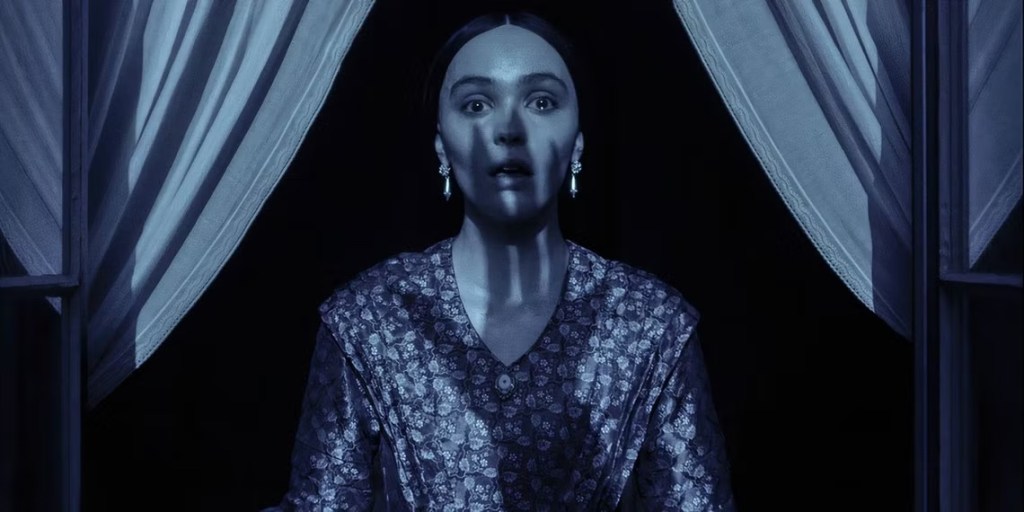
Where this “Nosferatu” differs from previous iterations is Eggers’ exploration of female desire and the many ways society tries to suppress their sensuality. He makes it clear from the opening sequence that this is Ellen’s film. We see how she fell under Count Orlok’s spell many years ago, and how now she yearns for intimacy from her husband, who sometimes brushes her off. Now that Thomas is gone, it gives this monster more power over her. The vampire possesses her on a nightly basis, and it’s impressively showcased through Depp’s physicality, which has her thrashing in bed, rolling her eyes back into her head, screaming and crying. It’s shocking that no CGI was used in these scenes, and even more shocking that the human body can contort in such ways. But it’s such a testament to all of Depp’s training for this film, and she is an absolute marvel to watch. When Ellen and Orlok meet in the night, their interactions are equal parts terrifying and captivating. You never know how they’ll react to each other, whether they’ll let desire or fear take over, and Depp and Skarsgård lean into their characters’ obsessions so seductively. The actress gets to shine in the film’s quiet moments too, especially as Ellen grows increasingly wary of the looming danger with Orlok’s arrival to town, worried over Thomas’ safety and frustrated that her hallucinations are dismissed by those around her, mainly Friedrich. It’s not until Professor Albin Eberhart Von Franz (Willem Dafoe, always a lovely addition to an Eggers film), a vampire hunter, arrives and takes her concerns seriously. If Count Orlok makes it to this small German town, they’re all in danger.
Eggers also infuses additional story elements to give his characters more agency. It’s not always needed — there are some overly stretched out moments in the middle — but it works well by the end of the film when Thomas, Friedrich and Von Franz team together to stop Orlok from sinking his teeth into the entire town. They all fill their expanded roles terrifically — Hoult with more gravitas as he tries to save his wife, Taylor-Johnson as a true manly man, and Dafoe succumbing to the madness of this story as only he can. Even Corrin, whose Anna doesn’t get much of a spotlight but serves as Ellen’s confidant, fits into this cast well. Simon McBurney as Herr Knock, Thomas’ boss, is also an absolute kick as he does Count Orlok’s bidding in town. Though he’s kept away from the main cast for most of the film, each moment with him is unexpected and wildly entertaining.
The technical aspects also sweep you into this macabre world. The unsettling production design (one creepy AF scene includes hundreds of rats in a crypt); the dark, gothic gowns; the impressive cinematography, which often relies on candle light or the night’s sky to illuminate a scene, or uses shadows for chilling effects; and the sinister-sounding string orchestra giving life to Robin Carolan’s complex score are all highlights.
“Nosferatu” has taken Eggers nearly 10 years to bring to the big screen, and it’s well worth the wait. This dark fantasy is the culmination of his already impressive catalogue of work, and further solidifies him as one of our most exciting and passionate filmmakers working today. It’s exciting to think of all that’s still to come from this auteur. My personal wish list includes him diving into Poe’s haunting stories — a sort of “game recognizes game” match made in heaven…or hell.
Score: 4 out of 5 stars
 Ema Sasic
Leave a comment