By Ema Sasic
Bright red painted toenails on a pink shag carpet; sharp, black cat eye makeup; fluffy fake eyelashes: This is how we’re introduced to Priscilla Presley in Sopia Coppola’s latest “Priscilla.” But remove all of the makeup, glitz and glam, and you see the woman whose entire world changed at such a young age and whose story is finally being shared.
Coppola has always had a deep understanding of women, both young and old, and the inner struggles they face. From her take on French monarch Marie Antoinette’s stifling time as a royal to a young woman’s yearning for distraction in “Lost in Translation,” the Academy Award winner always shows the humanity in her characters and how universal their stories are, whether or not they’re larger-than-life figures. It’s no wonder then that Coppola took on Priscilla Beaulieu’s story, and was the best director to handle the project.
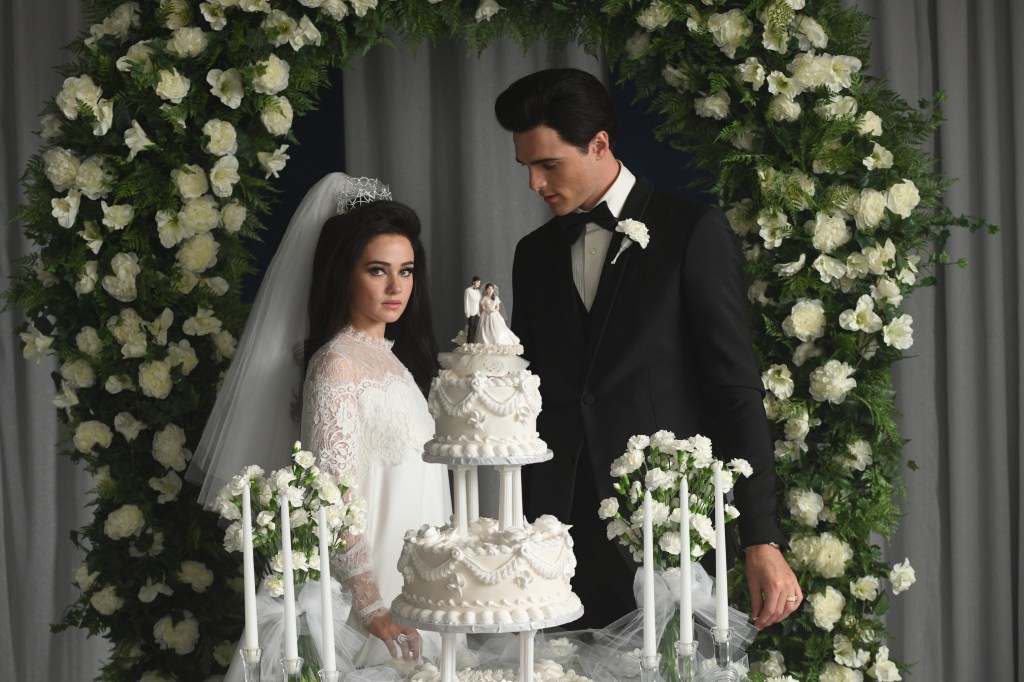
Adapted from Priscilla Presley’s 1985 memoir, “Elvis and Me,” “Priscilla” screams Coppola from the moment it starts. It is a deep exploration of innocent girlhood to suffocating adulthood, it has stylish sets and costumes that place us directly into the setting, and, above all else, there’s an overwhelming sense of sadness and loneliness from our heroine, despite living a life so many women wanted. The director treats her subjects and story with the utmost respect and care while not holding back from shining a spotlight on an untold, and often forgotten, perspective in this relationship. While Baz Luhrmann’s “Elvis” was all about the man and his rise to fame, “Priscilla” is a look at the private life they shared and how the sparkle eventually faded.
It’s easy to see why, for a number of reasons, Priscilla (Cailee Spaeny) fell for Elvis (Jacob Elordi). It’s 1959, and the 14-year-old and her family are stationed in a U.S. Air Base in West Germany, where she laments that there’s nothing to do. She’s seen sipping Coke and doing homework in a diner, which is about as much fun as one could have back then. One day, however, she’s invited to come to a gathering at Elvis’ home. Before she can go, she and a chaperone have to practically beg her parents for permission.
Spaeny has no problems convincing us she’s a young teenager who’s enamored by the man she sees in front of her. Wearing a modest dress, she’s shy and wide-eyed when she meets Elvis and stares in amazement as he croons on the piano to “Whole Lot of Shakin’ Going On.” The encounter is all that she can think about as she walks down her school hallway like she’s living a dream. When he invites her back, the moments only grow more surreal.
There’s no beating around the bush with the considerable age gap between Elvis (24) and Priscilla (14). While he was already a grown man, she was just barely a high schooler. But Coppola does a great job of placing the audience in the situation and not judging it. Elordi’s Elvis is grieving his mother’s death and he feels so homesick that Priscilla is a welcome presence in his life. For her, anything was better than her boring life, and when the King of Rock ‘n’ Roll looks your way, it’s hard to look away. The furthest their relationship goes in the beginning is kissing and hand holding, and anytime Priscilla does want to take it to the next step, he stops her and tells her he’ll know when the time is right.
It’s here where “Priscilla” stands out from so many other depictions of Elvis and Priscilla. Most will only focus on the musical genius, but Coppola reveals the man behind closed doors. Once Priscilla becomes a bigger part of his life, he starts dictating what clothes she should wear (the costume designs by Stacey Battat are impeccable) and how to do her eye makeup. She even starts taking uppers to keep her awake and downers to help her sleep. When she returns to West Germany after a visit to Graceland and Las Vegas, the disheveled, makeup-smeared girl8 we see is far from the one at the beginning of the film.
Once the teen begins living at Graceland — but not before her charming Southern boy has to convince her daddy and promise she would finish school — Priscilla experiences loneliness unlike any other. Elvis is often filming and forbids Priscilla from visiting, and she soon sees why when articles of him and his leading ladies are the top stories in newspapers and magazines. Elvis’ father Vernon (Tim Post) and his partner Dee (Stephanie Moore) show her no kindness either, as they tell her to stop making a show when she’s simply playing with her sweet poodle by the Graceland front gates, or when she wants to speak with some of the workers at the estate. Spaeny is heartbreaking and brilliant in these moments, and her eyes show all the hurt and desertion she feels. You can feel the disappointment when Elvis tells her to stay home and “be a good girl” when all she wants to do is be with the one who brought her to Graceland in the first place.
Elordi has a tough job in this film and he manages to bring so much to his performance. There’s a lot of pressure to portray the “real” Elvis as seen through Priscilla’s eyes, and he juggles many facets of this man throughout the film. He’s got the charm, look and the mannerisms, but he’s also got the bite that comes out in their private moments. But Coppola doesn’t entirely paint him in a bad light. In this version, he’s a young man who was more interested in women fawning over him and hanging out with his buddies than staying home with his girlfriend. Not that he’s not deserving of fault, but you also can’t entirely blame him for his actions, as if, in all honesty, others wouldn’t do the same. It was also a much different time compared to the one we’re living today, and his standards for women were clearly a product of it.
The film had a huge hurdle in its way when the Presley estate did not allow the use of his music, but the pop and rock songs used (like in “Marie Antoinette”) work perfectly to capture and amplify moods. Alice Coltrane’s “Going Home” and The Ronettes’ “Baby I Love You” drop us into her teenage world, and the wistful “Crimson and Clover” by Tommy James & the Shondells plays when Priscilla and Elvis share their first kiss. They truly saved the best for last, however, when Dolly Parton’s “I Will Always Love You” accompanies Priscilla’s departure from Elvis at the end of the film. The production design, specifically recreating Graceland and all its grand rooms, is impressive.
After being sidelined in most Elvis biopics, Priscilla deservedly gets the full attention in Coppola’s film. Many Elvis fans might not like seeing their king portrayed in less-than-ideal ways, but Priscilla’s point of view is an important one that gives us more insight into this giant and the life that they lived.
Score: 4.5 out of 5
 Ema Sasic
Leave a comment